
From Our Archives
Some text at the bottom of the original clipping is cropped. Missing passages are marked below rather than reconstructed.
Ida Hawkins, 81 and widowed, said the Lord sent nine strong men to fix the rotting roof of her 69-year-old house.
The men aren’t heaven-sent — they commute from prison.
The Atlanta Federal Penitentiary combined forces with Resource Service Ministries Inc., a group that helps the elderly poor, to form one of the few programs nationwide that frees federal prisoners for community projects.
“This place was rotting down around our ears,” said Mrs. Hawkins, who lives in the eight-bedroom house with her 87-year-old sister. They had moved to the ground floor to escape numerous leaks. “Thank God it’s livable again.”
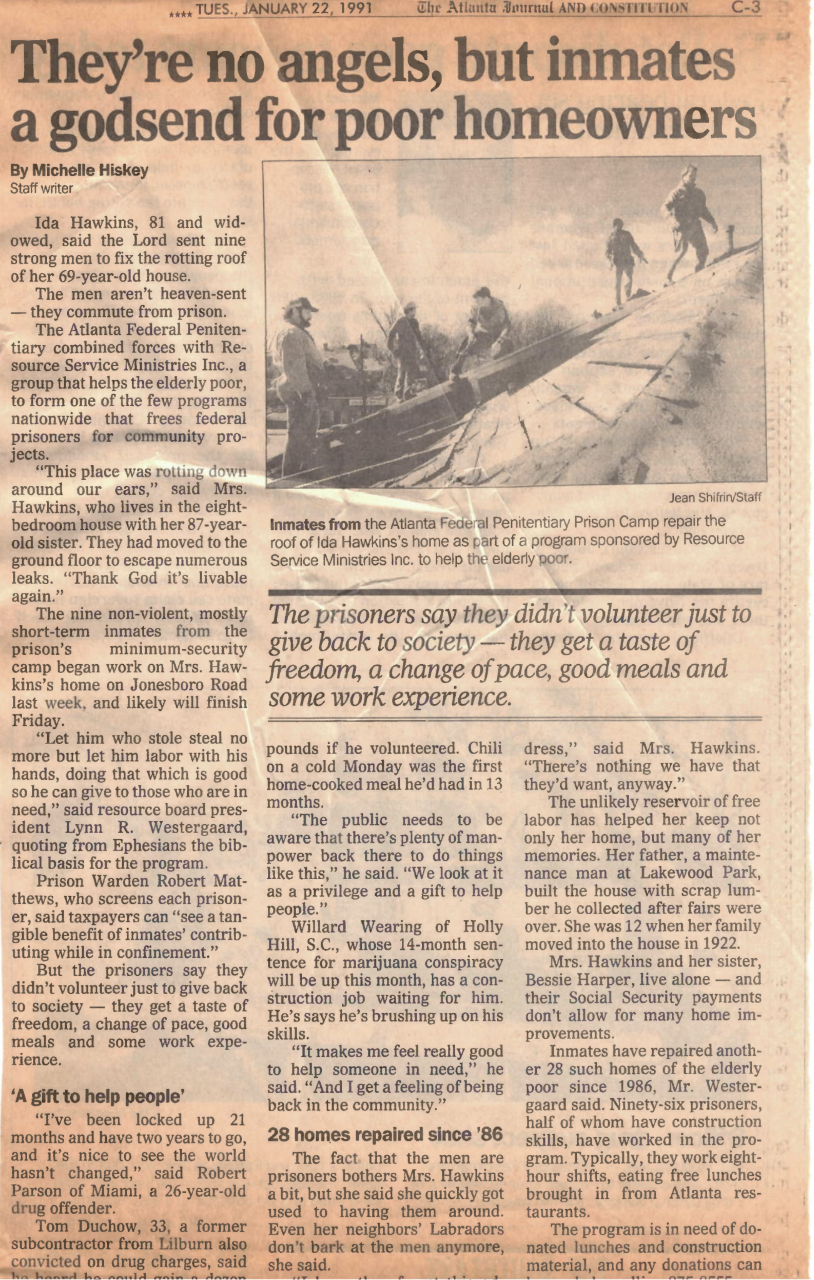
The nine non-violent, mostly short-term inmates from the prison’s minimum-security camp began work on Mrs. Hawkins’s home on Jonesboro Road last week, and likely will finish Friday.
“Let him who stole steal no more but let him labor with his hands, doing that which is good so he can give to those who are in need,” said resource board president Lynn R. Westergaard, quoting from Ephesians the biblical basis for the program.
Prison Warden Robert Matthews, who screens each prisoner, said taxpayers can “see a tangible benefit of inmates’ contributing while in confinement.”
But the prisoners say they didn’t volunteer just to give back to society — they get a taste of freedom, a change of pace, good meals and some work experience.
“I’ve been locked up 21 months and have two years to go, and it’s nice to see the world hasn’t changed,” said Robert Parson of Miami, a 26-year-old drug offender.
Tom Duchow, 33, a former subcontractor from Lilburn also convicted on drug charges, said he hoped he could gain a dozen pounds if he volunteered. Chili on a cold Monday was the first home-cooked meal he’d had in 13 months.
“The public needs to be aware that there’s plenty of manpower back there to do things like this,” he said. “We look at it as a privilege and a gift to help people.”
Willard Wearing of Holly Hill, S.C., whose 14-month sentence for marijuana conspiracy will be up this month, has a construction job waiting for him. He’s says he’s brushing up on his skills.
“It makes me feel really good to help someone in need,” he said. “And I get a feeling of being back in the community.”
The fact that the men are prisoners bothers Mrs. Hawkins a bit, but she said she quickly got used to having them around. Even her neighbors’ Labradors don’t bark at the men anymore, she said.
[cropped/unreadable beginning] dress,” said Mrs. Hawkins. “There’s nothing we have that they’d want, anyway.”
The unlikely reservoir of free labor has helped her keep not only her home, but many of her memories. Her father, a maintenance man at Lakewood Park, built the house with scrap lumber he collected after fairs were over. She was 12 when her family moved into the house in 1922.
Mrs. Hawkins and her sister, Bessie Harper, live alone — and their Social Security payments don’t allow for many home improvements.
Inmates have repaired another 28 such homes of the elderly poor since 1986, Mr. Westergaard said. Ninety-six prisoners, half of whom have construction skills, have worked in the program. Typically, they work eight-hour shifts, eating free lunches brought in from Atlanta restaurants.
The program is in need of donated lunches and construction material, and any donations can [cropped/unreadable continuation]
Inmates from the Atlanta Federal Penitentiary Prison Camp repair the roof of Ida Hawkins’s home as part of a program sponsored by Resource Service Ministries Inc. to help the elderly poor.
Jean Shifrin/Staff